- NIL Wire
- Posts
- In the Bediako saga, it’s Sankey vs. Alabama
In the Bediako saga, it’s Sankey vs. Alabama
It's rare for the SEC to air internal disagreements. But the Charles Bediako case is unique — and potentially disruptive.
Hey there,
Thanks for joining us for part of your weekend. Today, I’m sharing the latest on the Charles Bediako drama, Bobby Hauck’s retirement and the AUSL’s brilliant marketing. Money in college sports never stops. We’ll have more on that front next week.
Enjoy the Super Bowl.
— Kyle
Think You Know Amazon Prime? These 9 Perks Will Surprise You

You may think you know Amazon Prime, but these nine hidden perks might surprise you. From exclusive savings to unique features, these benefits could take your membership to the next level. Don’t miss out on perks you’re already paying for; unlock the full potential of Prime today.
THE BIG 3
In the Bediako saga, it’s Sankey vs. Alabama
The Charles Bediako eligibility saga isn’t over yet.
A Tuscaloosa County Circuit Court judge declined to rule Friday on whether the Alabama center can continue playing college basketball after signing an NBA contract and playing in the G League.
An affidavit filed in the case offers a rare, unfiltered look at where SEC commissioner Greg Sankey stands. And it’s not with Alabama.
Ross Dellenger of Yahoo Sports first obtained the affidavit, in which Sankey urged the court to uphold the NCAA’s eligibility rules, arguing they are “essential to the integrity of college sports, to the educational mission they serve, and to the opportunities they provide for current and future student-athletes.” That language is familiar to anyone who has followed college athletics governance, but what makes it striking is the author. Sankey is openly opposing one of his own member institutions in a high-profile legal fight.
That never happens in the SEC.
The SEC operates on unanimity and public cohesion. For decades, the expectation has been that internal disagreements stay internal. Mike Slive mastered that model, and Sankey has continued it, projecting strength through alignment. Which is why this break from Alabama is so instructive. It’s a line in the sand.
Bediako left Alabama three years ago to pursue professional basketball. In January, he was granted a temporary restraining order allowing him to play for the Crimson Tide, and he’s since appeared in four games.
Judge Daniel Pruet said Friday afternoon that a ruling would come “soon,” but the business day ended without one. When it does arrive, it won’t establish binding national precedent. Still, the ripple effects will be felt nationwide. Eligibility challenges like this are becoming more common, and every decision nudges the system in one direction or another.
Sankey’s concern, laid out clearly in his affidavit, is that granting eligibility would “open the door to undermining fundamental principles” of college sports. Allowing professionals to return freely and the downstream effects would be unavoidable. He argues for competitive balance and high school players.
“Inconsistent application of the NCAA eligibility rules challenged in this case, through court rulings or otherwise, fuels disruption in college sports,” Sankey wrote.
College athletics is already in a period of rapid change. Sankey, along with other conference commissioners and NCAA president Charlie Baker, is signaling that the NCAA’s eligibility rules aren’t open to interpretation.
Good coaches are walking away from college sports
College football coaches are paid extremely well, which is why my default reaction to their complaints about how hard the job has become is a well-practiced eye roll. That was my reaction last month to former Kansas State coach Chris Klieman’s comments about retirement.
Every job evolves. Every industry changes. Welcome to the club.
BUT … I’m starting to hate how many genuinely good coaches are walking away from the sport. The latest is Montana’s Bobby Hauck, a fixture in the FCS world who led the Grizzlies to four national championship appearances. Hauck isn’t leaving because he can’t coach anymore. He’s leaving because coaching just isn’t fun anymore.
“Dealing with what college football has become is not always enjoyable as a head coach,” Hauck said. “I want to enjoy my job, and a lot of the head coach stuff in current-day Division I college football is not enjoyable.”
The modern college football calendar never stops. There is no true offseason. The transfer portal and NIL have turned roster management into a year-round exercise in re-recruiting your own team while simultaneously battling agents and the next shiny offer. Some coaches are wired for that environment. Others, even very good ones, aren’t.
You don’t have to feel bad for highly compensated coaches to acknowledge the reality that the job has changed dramatically in just five years. The daily, weekly, monthly grind looks nothing like it did a decade ago. It’s less teaching and coaching, more managing, negotiating and putting out fires.
What finally pushed Hauck to his decision was the same warning sign that applies to any profession: He didn’t look forward to going to the office.
That’s the universal red alert that it’s time to reassess things.
“We wouldn’t be sitting here today if I ever wanted to be a head coach, because if I ever wanted to be a head coach, it would be here at the University of Montana,” Hauck said. “It does not have allure for me anymore.”
The TV ratings and booming interest in the sport are awesome. But when lifers lose the allure, it’s an issue.
Some brilliant branding in pro softball
Here’s a college sports story involving a professional league — but it’s different from the issues we’ve been reading about recently.
Instead of skirting eligibility rules, this story highlights a savvy, forward-thinking business move.
The Athletes Unlimited Softball League, which launched last year, signed Tennessee star Karlyn Pickens to an NIL deal. Under the agreement, Pickens will appear in the pro league’s marketing initiatives and social media campaigns, lending her profile to the league despite not playing in it.
Pickens is one of the most dominant pitchers in the sport and has already etched her name into the record books, throwing the fastest pitch in college softball history — twice. From a branding standpoint, bringing her into the AUSL ecosystem is an obvious win. Her rising national profile and credibility with fans give the league instant visibility and relevance, even while she remains in college.
The timing is ideal. Backed by Major League Baseball, the AUSL is positioned to capitalize on the continued surge in women’s sports. With ESPN already broadcasting games, the league’s growth strategy is clear: align with recognizable talent and meet fans where they already are. Pickens’s involvement in the AUSL is a textbook example of how pro leagues can leverage NIL to build momentum before players even turn pro.
VIDEO OF THE WEEK
Tax law as recruiting strategy
This is a cheeky tweet by the Central Florida social media team. But don’t forget: Every joke has a grain of truth. Some players have probably already made transfer decisions based on tax considerations, and those choices will undoubtedly increase in the future. We’ve already seen that in professional sports. Schools in Florida, Texas and Tennessee aren’t going to gobble up every valuable player because of their lack of state income taxes, but it won’t hurt. And they would be wise to advertise it like UCF.
Introducing NIL Agency Tycoon 95
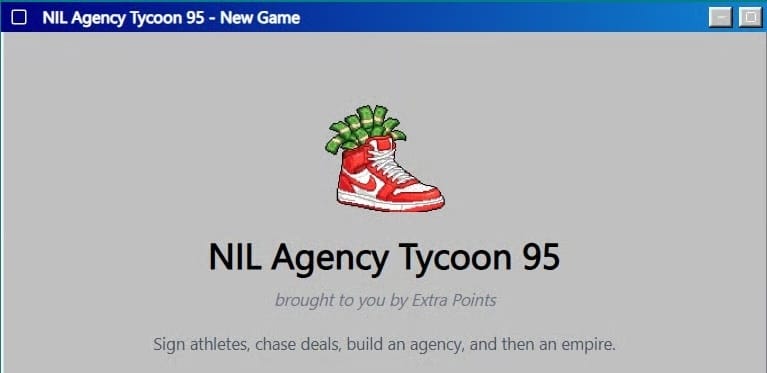
Last week, Extra Points announced a new addition to its free game library: NIL Agency Tycoon 95.
The objective of the game: to build a college athlete representation empire. You try to pitch various athletes to become your clients, track down marketing gigs for them, negotiate contracts and finagle revenue sharing deals with collectives.
It’s a lot of resource management, and you have to juggle internal investments (new offices, marketing staff, NCAA certifications), athlete recruitment and the work it takes to pull off enough successful marketing campaigns with Division III baseball players to actually pay your rent.
NIL BLITZ
♦️ Ross Dellenger had an update on Congress and college sports.
♦️The SEC distributed over a BILLION dollars to member schools last year.
♦️ Houston basketball coach Kelvin Sampson went on a screed about Houston’s athletic department being poor. Then, he reversed course.
♦️ Former UCLA basketball player Amari Bailey, who’s played in the NBA but is trying to return to college, is setting up official visits.
♦️ Texas athletic director Chris Del Conte joined a growing chorus calling for the elimination of conference championship games, which would move up the College Football Playoff calendar. The Athletic’s Seth Emerson highlighted how the calendar could soon shift.
♦️ Here’s a good discussion with Purdue AD Mike Bobinski about two headline topics: NIL and the enforcement of rules.
♦️ UTEP football coach Scotty Walden is donating $80,000 of his salary to the school’s revenue-sharing fund.
Share NIL Wire
Have a friend or colleague who would enjoy NIL Wire? Share with them today!
You currently have 0 referrals.
BATTER UP
Today’s Poll Question:
Should courts be involved in NCAA eligibility cases? |
Last Edition’s Poll Results:
Do Blue Bloods still rule college sports?
Yes - 61%
No - 39%
“I just haven’t been enjoying it enough.”