- NIL Wire
- Posts
- The CSC had its eye on LSU — for a minute, at least
The CSC had its eye on LSU — for a minute, at least
LSU's being investigated! But not football! And, wait, it's resolved! Talk about anticlimactic. Plus: Check out this Clemson basketball player's reunion with her mom. We dare you not to cry.
Hello.
Hope everyone had a great weekend. Thanks for spending part of your day with NIL Wire.
I have a heartwarming NIL story to share today, plus football players opening up about NIL and the transfer portal at the Senior Bowl, San Diego State settling a Title IX lawsuit and the CSC (briefly) coming after LSU. What does it all mean? We’ll try to provide clarity.
— Kyle
Unlock Amazon Prime Perks You Never Knew Existed

Amazon Prime offers much more than just free shipping! Ensure you're getting the most out of your membership with help from our deal experts. Discover nine Prime benefits you should be using.
When NIL turns basketball players into travel agents
Not every NIL story involves a quarterback or a point guard signing a seven-figure deal.
Sometimes, it’s the most wholesome story you’ll hear all week.
Athletes have used their newfound NIL opportunities to give back to their communities, and what the Clemson women’s basketball team recently pulled off belongs in the NIL Hall of Fame.
Guard Rusne Augustinaite is from Lithuania, 5,000 miles and an ocean away from little ol’ Clemson, South Carolina. Geography has prevented her mom from seeing a game for seven years.
So her teammates decided to fix that.
Quietly behind the scenes, the Tigers pooled their NIL money and planned the ultimate surprise. When the moment arrived, it was caught on video. Augustinaite opened the door and froze, stunned by who was staring back at her. Then mom, daughter and teammates let the tears flow.
“It felt unreal,” Augustinaite said. “I didn’t expect that at all.”
If that were the end of the story, it’d already be a winner. But it somehow got even better.
On Thursday night, with her mom watching from the stands, Augustinaite poured in a season-high 21 points in a blowout win over SMU.
The plan came together over Thanksgiving and even required a translator because Augustinaite’s mom doesn’t speak English. A flight delay pushed the reunion to around midnight, well past Augustinaite’s usual 8:30 p.m. bedtime. Her teammates sold it as a “team bonding activity.”
It was worth the wait.
“This is not a facade. It ain’t fake,” Clemson coach Shawn Poppie said. “This is genuinely a family that loves one another and wants the best for one another.”
NIL can buy a lot of things. On this night, it bought something priceless.
NIL causing locker room discomfort? Not so much, it turns out.
Chris Perkins, the longtime Miami Dolphins columnist for the South Florida Sun Sentinel, attends the Senior Bowl annually, giving him a vantage point on how elite college prospects view the sport’s shifting landscape. In conversations with former college players this year, Perkins found a notable change in tone: The transfer portal and NIL are increasingly viewed as less problematic than in prior seasons.
It’s important to note that these perspectives come primarily from players positioned to benefit most from the current system. Even so, Perkins’ reporting offers a valuable window into how athletes are processing the realities of modern college football.
Texas safety Michael Taaffe sounded like a head coach, believing that NIL would favor the wealthiest and most successful programs. But Taaffe admitted that his assessment was wrong, highlighted by Indiana completing an improbable 16-0 national championship season.
Clemson running back Adam Randall struck a tone similar to his head coach, Dabo Swinney, suggesting that NIL and the portal can incentivize players to prioritize immediate financial gain over long-term development. Taaffe delivered an opposing viewpoint, not faulting players for transferring to better financial situations.
According to Perkins, this represents a clear evolution from the discourse he heard at the Senior Bowl in 2024, when UCLA edge rusher Laiatu Latu argued that NIL had “ruined college football.” Recently, Dolphins rookie safety Dante Trader Jr., who played at Maryland, told Perkins that NIL could erode team culture. Those concerns echoed a common refrain among coaches in the early NIL era, one that often overlooked a basic reality of professional sports and labor markets more broadly: Compensation has never been the same across the board. In fact, unequal pay structures exist in every functioning industry.
University of Miami center Blake Brockermeyer Jr., a three-time transfer, offered perhaps the most nuanced assessment. While acknowledging that the portal “does present certain issues,” he emphasized that each situation is highly contextual, resisting blanket judgments about player movement.
It is also unsurprising that many Senior Bowl participants expressed skepticism about unproven freshmen earning salaries comparable to established veterans. That perspective aligns with long-standing practices in professional sports, where rookie wage scales exist to mitigate risk. Investing heavily in unproven talent can destabilize rosters, and there are early signs that traditional power programs, particularly those that continue to recruit heavily from high school, are recalibrating how they allocate NIL resources to incoming freshmen.
The overwhelming consensus among players Perkins spoke with was that NIL-related financial disparities are not creating meaningful tension inside locker rooms. Instead, paying players has been normalized. It’s just another feature of the college football ecosystem.
A Title IX settlement could have ripple effects through women’s sports
Title IX lawsuits have surged in recent years, reflecting renewed scrutiny of how colleges allocate athletic opportunities and resources. One such case reached a settlement last week — and it could carry implications far beyond a single campus.
San Diego State agreed to pay $300,000 to former female athletes who brought a class-action lawsuit alleging the university failed to provide athletic opportunities proportional to women’s enrollment. The university also agreed to pay $1.3 million to cover the plaintiffs’ attorneys’ fees, court costs and expenses, according to Sportico.
If approved by the court, the settlement would mark the first time student-athletes have received monetary damages in a Title IX case involving disproportionate athletic financial aid, perhaps setting a precedent for future Title IX cases.
The plaintiffs alleged that female athletes were deprived of approximately $1.2 million in athletic financial aid during the 2019–20 and 2020–21 academic years. Under the settlement terms, the $300,000 payment will be distributed among 826 women who competed from 2018 through 2025 and “did not receive all of the athletic financial aid they could have received.” An equal distribution would amount to $363 per athlete.
The settlement includes several structural reforms. San Diego State must hire an independent expert, selected in consultation with the plaintiffs, to conduct a comprehensive Title IX gender equity review of its athletics program. The university also agreed to provide equitable meals and nutritional support, expand access to air travel for teams competing in away games more than six hours from campus and offer opportunities for teams to stay in hotels prior to competition.
The settlement does not address Title IX compliance related to NIL or revenue-sharing payments.
San Diego State emphasized that the agreement does not constitute an admission of wrongdoing.
“The settlement expressly states that any payments are non-precedential and are not an agreement that student-athletes are entitled to damages,” the university wrote in a statement provided to Sportico. “As part of the settlement, the university maintains its position that it did not violate Title IX, and the court did not make any determination as to which side is correct.”
Whether the settlement proves to be a legal outlier or the first step toward broader Title IX damages claims will be answered in the next wave of litigation.
More news and links:
Gymnasts are pushing NIL to new heights.
A trial date for Jaden Rashada’s NIL lawsuit against former Florida coach Billy Napier has been set.
A bill allowing high school athletes to earn money off their name, image and likeness has been introduced in the Mississippi House of Representatives.
New Playfly president Chris Marinak discussed the company and college sports.
College basketball stat guru Evan Miya took an interesting look at how international players compare to true freshmen.
DOWN TO BUSINESS
The CSC had its eye on LSU — for a minute, at least
All that for that?!
When the Athletic reported last Friday that LSU was under investigation by the College Sports Commission, the assumption was immediate and obvious: This had to involve football. LSU has been among the most aggressive programs in the transfer portal, and the sums tied to recent quarterback pursuits have been impossible to ignore.
That assumption, however, proved premature. NOLA.com reported that football was not the sport under investigation. Then, on Monday night, LSU released a statement announcing that the matter had already been resolved.
“The CSC inquiry into non-reporting has been resolved with no disciplinary action, and any deals that require submission to NIL Go have been submitted,” the statement read. “We appreciate the CSC’s prompt review and resolution.”
Notably absent was any indication of which sport triggered the inquiry.
Here’s the background: In January, Washington quarterback Demond Williams was linked to LSU before ultimately remaining in Seattle, with a reportedly prohibitive buyout playing a decisive role. Soon after, Arizona State transfer Sam Leavitt committed to LSU. Around the same time, Yahoo Sports reported on a proposed $3.5 million NIL arrangement involving LSU’s multimedia rights partner, Playfly, and Cincinnati transfer quarterback Brendan Sorsby, who eventually signed with Texas Tech.
That story proved pivotal. It prompted the CSC to issue a notice expressing concern about third-party NIL deals that could violate the terms of the House settlement, specifically those involving multimedia rights partners. Those concerns go to the heart of the CSC’s mandate: distinguishing legitimate NIL compensation from arrangements that resemble pay-for-play.
Coaches and administrators at every level have been calling for clarity, structure and enforcement. For the first time, it looked like the system would be tested. Instead, it fizzled.
This could have easily been a misunderstanding, and LSU might have done nothing wrong. But the optics aren’t great. LSU, but not the football program. Quick resolution with no punishment. It feels like another instance of the CSC having zero teeth.
The issue was most likely a failure to report an NIL deal of $600 or more, transactions that must be disclosed and approved through the CSC’s NIL Go clearinghouse. Some administrators have publicly acknowledged attempts to skirt NIL Go requirements, effectively daring the CSC to enforce its rules.
There is widespread skepticism about the CSC’s enforcement authority, particularly because not all power conference schools have signed the participation agreement. Several state attorneys general have advised universities in their states not to sign it.
That uncertainty is precisely why this moment mattered.
Introducing NIL Agency Tycoon 95
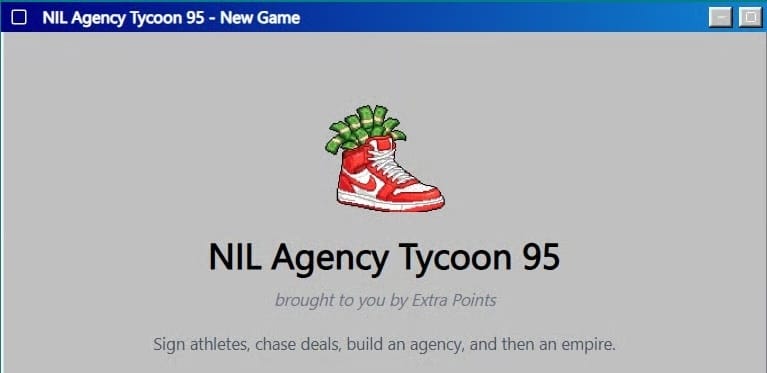
Last week, Extra Points announced a new addition to its free game library: NIL Agency Tycoon 95.
The objective of the game: to build a college athlete representation empire. You try to pitch various athletes to become your clients, track down marketing gigs for them, negotiate contracts and finagle revenue sharing deals with collectives.
It’s a lot of resource management, and you have to juggle internal investments (new offices, marketing staff, NCAA certifications), athlete recruitment and the work it takes to pull off enough successful marketing campaigns with Division III baseball players to actually pay your rent.