- NIL Wire
- Posts
- OMG! The NCAA tournament selection committee actually got it right!
OMG! The NCAA tournament selection committee actually got it right!
Why the 2026 tournament bracket makes sense
Good morning, and welcome to one of the most fun weeks of the year!
The madness starts tonight with Howard and UMBC. We have a college basketball-heavy NIL Wire slate today to get you primed for the tournament. On Thursday, we’ll have a fun behind-the-scenes look at how hectic life is while preparing for the tourney. No more spoilers!
To kick off the men’s NCAA tournament, we’re hosting a bracket challenge with Extra Points, thanks to our pals at Short Courts.
Short Courts makes beautiful and authentic framed replica courts and football fields, perfect for your donors, fans and fundraisers. Designed to celebrate your program and thank the people who make it possible, Short Courts are handcrafted and customizable for any occasion. Check out example courts and fields here.
Here are the details:
The Bracket Challenge is open to ALL Extra Points and NIL Wire readers, not just premium subscribers. If we’ve got your email, you’re welcome to enter the challenge.
Simply fill out your bracket here. Limit one per person.
The winner of the bracket challenge will get their very own Short Court of the team of their choice, along with some additional Extra Points and NIL Wire prizes. The second and third place winners will also get free Extra Points and NIL Wire Premium subscriptions. Winners will be notified shortly after the championship game.
No purchase necessary, no cash collected. We’re not out here trying to get anybody in trouble with the NCAA.
— Kyle
KICKOFF
Luke Combs is wrong: App State belongs in FBS
When a powerhouse FCS program moves up to FBS, the same question always follows: how will the fan base respond when national championships are no longer the expectation?
Appalachian State, Georgia Southern, James Madison and Delaware show how differently that transition can play out. All four were dominant forces in FCS. All four chose to step into a deeper, more resource-heavy competitive environment. The results have been mixed.
Appalachian State set the early blueprint for what a successful move could look like. The Mountaineers began their FBS era with nine consecutive winning seasons, including five with double-digit wins. They were widely viewed as one of the premier Group of Five programs.
But they’ve leveled off in recent years, with a 25-25 record since 2022. During the past two seasons, App State has won 10 total games. For a fan base accustomed to competing for championships, that kind of mediocrity is difficult to accept. The frustration was voiced publicly last week by the school’s most famous booster, country music star Luke Combs, during an appearance on the Bussin’ with the Boys podcast.
Combs was candid about both the direction of the program and his reluctance to contribute financially to NIL.
“I’m not donating,” he said. “I feel like I need some concessions. I need some assurances.”
He suggested that programs like Appalachian State face significant challenges in the modern transfer portal and NIL landscape, where roster retention often depends on financial resources.
“I just don’t know that in the portal era that we’re in now that a school like us, and this is going to be such a hot take, and I’m going to get absolutely eviscerated by our fans – I would love to see us go back down to FCS because there’s a chance to win a national championship,” Combs said.
Using James Madison as an example, Combs argued that the best-case scenario for a program like Appalachian State might be making the playoff only to lose to Oregon by 50 points. It’s an interesting debate that reflects the growing economic divide. But the argument for remaining in FBS remains strong, particularly for a program like Appalachian State.
The athletic department has the infrastructure, fan support and national brand to consistently contend at the G6 level. Few programs outside the power conferences carry the recognition App State has built over the past two decades. They’ve beaten major programs, played in nationally relevant games and built a reputation that resonates well beyond the Sun Belt. Visibility matters. The expanded playoff provides a legitimate pathway to reach the sport’s biggest stage. Being part of the national conversation is a far more prominent position than dominating FCS.
Appalachian State isn’t going to win a national title in basketball, but making the NCAA tournament still creates enormous excitement and exposure. Where the debate becomes more understandable is at a place like Georgia Southern. The Eagles were one of the most dominant programs in FCS history, but since moving to FBS, they’ve been irrelevant. When national championships are replaced by mid-tier bowl trips to Montgomery or Mobile, it’s fair for fans to question whether the tradeoff was worth it.
March Madness’ viral boombox manager is back for another run
One of the biggest stars of March Madness is back.
Not Duke. Not Kentucky. Amir “Aura” Khan, the boombox-toting student manager who became the unlikely face of the McNeese Cowboys’ tournament run last year.
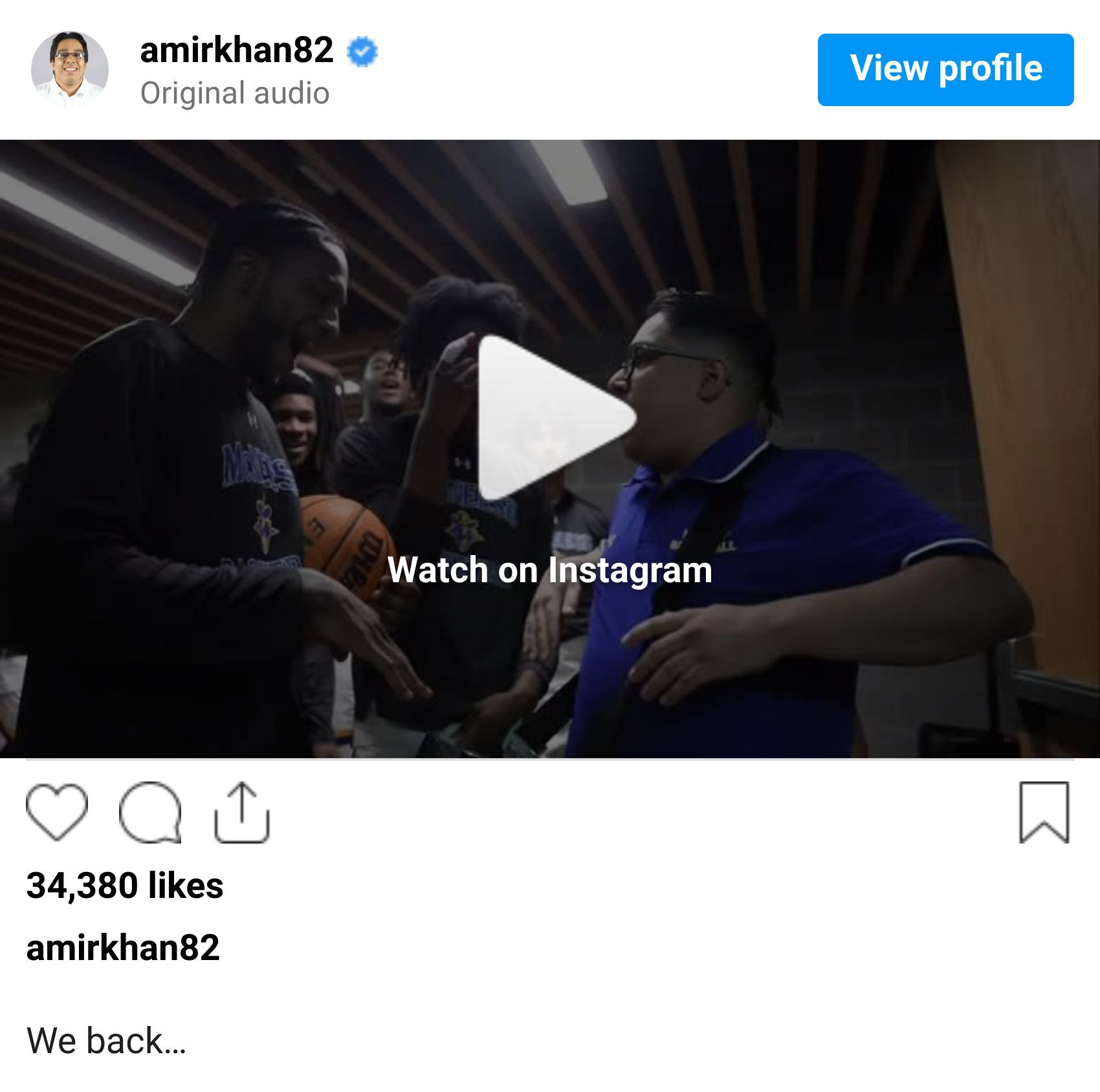
Khan turned a pregame walkout into a viral moment when McNeese stunned Clemson. Suddenly, the manager with the speakers had as much spotlight as the players.
Welcome to the NIL era, where it isn’t just athletes cashing in.
After going viral, Khan signed more than a dozen deals, including partnerships with Buffalo Wild Wings, TickPick, TurboTax and Insomnia Cookies, according to Front Office Sports. Topps even made a bobblehead of his likeness.
“It feels like a dream, and I’m going to wake up one day,” Khan told FOS last week. “It doesn’t feel real.”
At the height of the craze, McNeese cheerleaders wore t-shirts with Khan’s face on them. He briefly followed coach Will Wade to NC State before transferring back to McNeese. Now a recent graduate, Khan is eyeing a career in sports media or coaching, ideally as a graduate assistant on McNeese’s staff next season. If that happens, he might be the only GA in the country with an agent.
With nearly 100,000 Instagram followers and a brand built on “aura,” Khan has already proven something rare in college sports: sometimes the biggest March Madness star isn’t on the court.
How one upset got the MAC an additional $2 million (and maybe more)
Mid-American Conference commissioner Jon Steinbrecher would never say it publicly. But he didn’t shed many tears when Miami (Ohio) lost in the MAC tournament. He may have even given a fist pump when UMass upset the RedHawks.
Why? Because it made the MAC a two-bid league for the first time since 1999. And that means money.
The NCAA distributes tournament revenue through “units.” Each unit is worth $2 million, so the MAC is guaranteed $4 million. And that number will grow if Miami and Akron win a game (or two). The MAC distributes the initial units among all 13 member schools evenly. Additional earnings are tied to team success.
For a conference that operates on paper-thin budgets, the difference between one bid and two can be enormous. MAC athletic departments run on annual budgets that are a fraction of what major conference schools spend on football alone. $6 million or $8 million – if things break right – is a meaningful infusion of resources. (Units are paid out over six years.)
None of this is meant as a slight toward the MAC. It’s simply the economic reality facing every non–power conference and its members in college athletics. The financial gap between the sport’s richest leagues and everyone else continues to widen, making every available revenue stream critical.
Which is why Steinbrecher wanted anyone other than Miami to win the MAC tournament, whether he admits it or not.
More news and links:
Devon Handerson of The Athletic has a good piece on the finances of Sacramento State’s MAC deal and if it will be as good as perceived.
Sportico’s Daniel Libit has details about the 18 Nebraska players who went to arbitration with the College Sports Commission and who is representing them.
Porter Moser will return to Oklahoma next season with increased program investment in NIL.
Jim Gazzolo of the American Press wrote a good column on McNeese AD Heath Schroyer and how he’s elevated not just McNeese athletics, but the Southland Conference.
Coastal Carolina AD Chance Miller appeared on the Higher Ed Athletics podcast, where he discussed the return on investment of not charging for concessions.
The College General Managers Association announced its launch as a national non-profit organization composed of NCAA general managers.
Keep Your Phone. Slash your bill to $25 with Metro by T-Mobile.
Looking for a way to cut down your phone bill without the hassle of buying a new device? Check out the new $25 BYOD plan, which lets you keep the phone you already love and save money. This plan offers the same great value every month with absolutely no contracts, no credit checks, and no unexpected surprises.
Best of all, this price is guaranteed for 5 years, meaning you don’t have to worry about your bill increasing. All while running on America’s Best Network (according to OOkla speedtest).
In addition to wireless service, the $25 BYOD plan includes access to features like Scam Shield, which helps block unwanted calls, and T-Mobile Tuesdays, which offers weekly deals and promotions. These extras don’t replace the value of the plan itself, but they are a nice bonus that helps stretch your dollar further.
Exclusions apply. Must turn on AutoPay (first month $30, then $25/mo thereafter w/ AutoPay. No ID required to sign up. Limit 5 Per BAN.
DOWN TO BUSINESS
Rejoice! For once, the selection committee got it right.
The Monday after the NCAA tournament bracket is released is easily predictable. Sports-talk radio fills with outrage. Fans rage about snubs. Analysts dissect baffling decisions by a selection committee that has historically shown a remarkable ability to get things wrong.
For years, the same complaints surfaced: undeserving major conference teams sneaking into the field while accomplished mid-majors were left behind. Not in 2026.
Sanity has prevailed. Miami (Ohio) made the field. Auburn and Oklahoma did not. The committee got the most important part of the process right – selecting the correct teams.
Sure, there are quibbles about seeding. Duke probably didn’t get fully rewarded for earning the No. 1 overall seed. But those arguments are secondary. The integrity of the tournament begins with putting the right teams in the bracket, and the committee delivered.
The power conferences still dominated the at-large pool, which is expected and justified. But deserving mid-majors were rewarded for strong seasons. That balance is exactly how the process is supposed to work. The clearest evidence came from the internet’s reaction, or non-reaction. Social media was unusually calm Sunday night and Monday morning.
Even David Worlock, the NCAA’s media czar, joined the conversation, tweeting, “We aim to disappoint,” after a fan pointed out how little outrage followed the selection show.
When X – the home of the loudest and most aggrieved voices in sports discourse – is mostly quiet, it means the committee got it right. That silence stands in sharp contrast to previous years. Last season, the process was marred when North Carolina’s athletic director chaired the committee and an underwhelming Tar Heels team found its way into the field. The optics were horrible.
Those types of decisions have fueled the perception that mediocre high-majors receive preferential treatment over mid-majors with stronger resumes. Part of the problem stemmed from the introduction of the NET in 2018, which replaced the RPI and quickly developed a reputation for favoring teams from power conferences. This year – thankfully – another metric gained traction: Wins Above the Bubble, or WAB.
That shift helped restore balance between big and small. Mid-majors that consistently won games were rewarded, while struggling high-major teams were no longer protected by their schedules. A historically weak bubble was another factor. Auburn and Oklahoma simply didn’t build tournament-caliber resumes.
The committee essentially answered two longstanding questions Does it matter if you win nearly every game, even if your schedule isn’t loaded with elite opponents? And does playing a brutal schedule excuse you if you consistently lose those games?
Texas and SMU were rewarded for collecting quality wins. Auburn was punished for finishing with 16 losses and going 7-15 against Quad 1 and Quad 2 teams. Difficult schedules can strengthen a resume – if you win games.
Critics spent months dismissing Miami because of its schedule. But the committee focused on the bigger picture – Miami won 31 games and dominated the Mid-American Conference. The committee delivered a message to the Miami haters by awarding them for winning and the attempt to schedule difficult games.
All of this added up to something extremely rare: harmony. Fifth-seeded Vanderbilt and St. John’s both have reasonable arguments that they should have landed on the 3 or 4 line. But if that’s the biggest controversy in an era where people can complain about the color of the sky, the grass and stop signs, it might qualify as a bigger miracle than nuclear fission.
Hopefully, future committees take note.