- NIL Wire
- Posts
- Could Utah’s PE deal be ... a good investment?
Could Utah’s PE deal be ... a good investment?
I'm sharing my two cents on the arrival of private equity in college sports, plus more on jersey patches, Fernando Mendoza and Texas A&M women's volleyball's big upset.
Howdy,
In today’s newsletter, we’ve got updates on jersey patches and my two cents on Utah’s foray into private equity … plus a note on Texas A&M’s takedown of Nebraska and Fernando Mendoza’s wholesome moment with his Indiana teammates! Read up on the latest news from around the NIL world.
Do you follow us on Twitter, Instagram, TikTok or Facebook? You should! Click the link to stay updated on all your social channels. We’d also love to hear feedback on anything and everything about our newsletter. Hit reply or send us an email at [email protected].
— Kyle
NIL That Works For Every Athlete

NIL doesn’t need to be complicated. Athletes shouldn’t have to spend hours begging other brands for a couple bucks and a sample size of their product.
Athletes should be focused on building their brands. And building their fan bases. That’s what leads to real, sustainable revenues.
And that’s what FanSpark was made for.
FanSpark lets every athlete build and monetize a global fan base. And we made it simple, so you can spend more time focusing on your athletic and academic success.
You post exclusive social content on FanSpark
With one click, your top fans can subscribe to you for more content
You get 80% of the subscription revenue, we get 20%
Fans around the world discover your content on FanSpark, launching your fanbase from local to global
Never worry about dealing with DMs, PPV content, betting or tips again.
NIL shouldn’t be complicated. FanSpark is simple. So every athlete can build and monetize a global fan base.
Sign up at FanSpark.pro or get in touch to learn more.
KICKOFF
Legal or not, jersey patches have already arrived
In January, the NCAA is expected to approve sponsored jersey patches for the 2026-27 calendar, marking the beginning of a new surge of revenue streams for athletic departments.
UNLV got in early, announcing a five-year, $11 million deal with Acesso Biologics, whose logo will adorn the Rebels’ football, baseball and men’s and women’s basketball jerseys. Learfield brokered the agreement, believed to be the first jersey-patch deal in college sports.
Acesso Biologics is a Las Vegas-based regenerative medicine company.
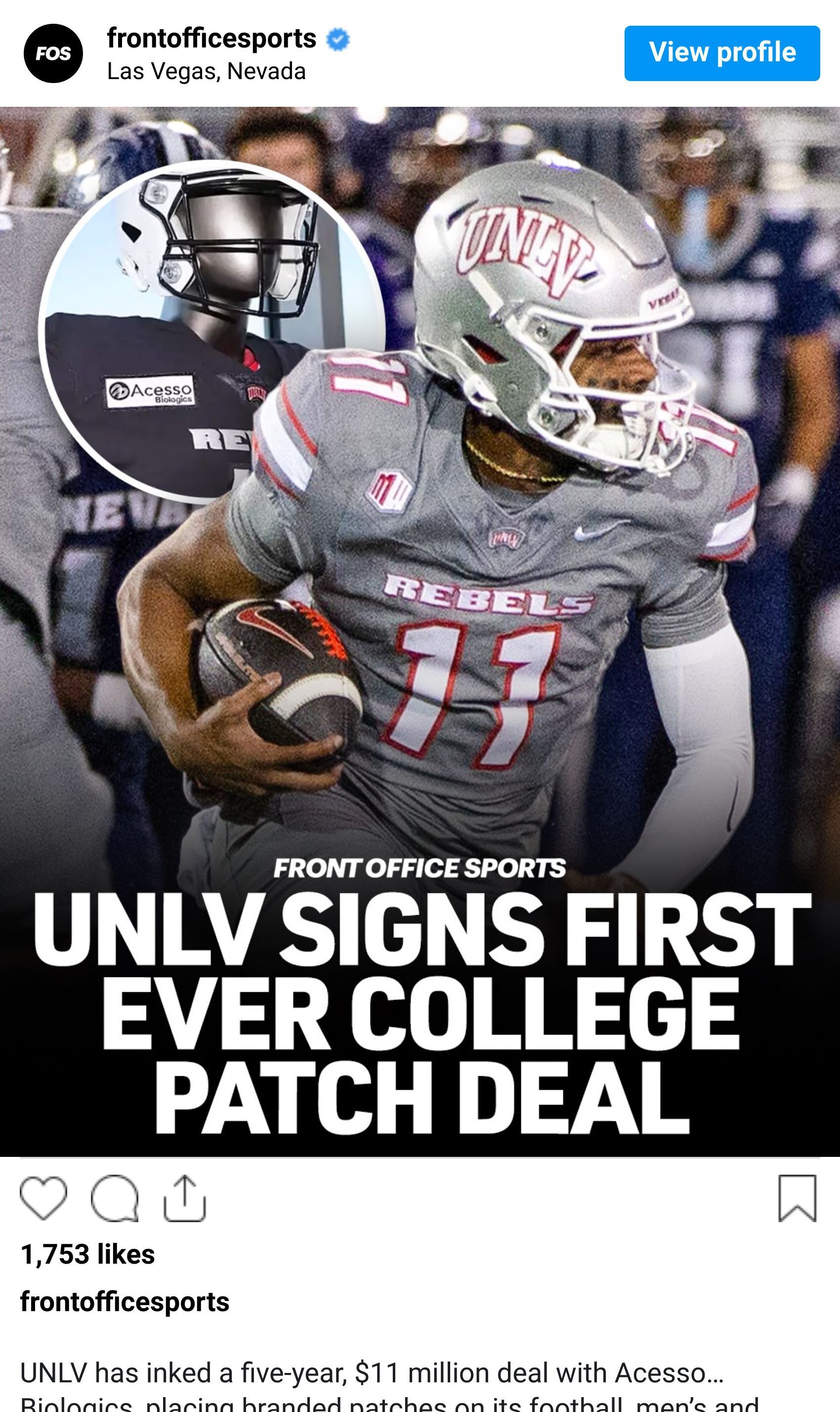
Being proactive is now a prerequisite for athletic departments. Jersey patches were an inevitable entry into college sports. It will cause some pushback from traditionalists, but we’re so far past the point where commercialization would cause an uproar, unless, of course, you rename an iconic stadium.
Professional teams have had jersey patches for several years now, which should help quiet some of the criticism. Most stadiums also have field logos. It doesn’t make it right, nor does it mean people shouldn’t complain. But the abundance of ads and company logos in college sports has reduced most opposition to rubble.
The NCAA’s Division I Administrative Committee introduced a proposal in October to allow jersey patches. If the rule change is accepted, it would take effect in August.
I’m here for White Castle on Ohio State’s jerseys, Domino’s on Michigan’s and Krystal on Alabama’s.
VIDEO OF THE WEEK
Down goes Nebraska 🌽
The upset of the weekend took place in the NCAA women’s volleyball tournament, as undefeated No. 1 Nebraska lost, 3-2, to Texas A&M. It was Nebraska’s first home loss since Nov. 26, 2022. Incredibly, despite being one of the sport’s most dominant programs, Nebraska hasn’t won the national championship since 2017.
This is Texas A&M’s first trip to the national semifinals.
DOWN TO BUSINESS
Could Utah’s PE deal be a good investment?
Imagine getting a time machine and going back to, let’s say, 2015. Ten short years ago. One decade.
Back then, if a university gave an athlete cream cheese for their bagel, it could trigger NCAA scrutiny and end with a multi-page report from the committee on infractions.
Now, return to the present day. You might as well have jumped 100 years into the future. College sports has evolved at warp speed — mostly for the better, in my opinion.
Will the next seismic change — private equity — belong in that category?
Last week, the University of Utah’s board of trustees unanimously approved a groundbreaking deal with Otro Capital, making Utah the first athletic department to accept private equity funding. (Days later, the Big 12, the conference that houses Utah’s sports, was reportedly nearing a $500 million private capital deal.)
Utah’s plan is ambitious. The school is creating a for-profit entity, Utah Brands & Entertainment LLC, to oversee its revenue-generating assets: tickets, concessions, sponsorships, merchandise, trademarks, licensing, etc. Donors can participate, and Utah estimates the arrangement could generate up to $500 million. Plenty has been written and spoken about the topic. Our friend Matt Brown at Extra Points offered a thoughtful breakdown last week.
It’s not hyperbole to say private equity is as unpopular as people who eat Cool Ranch Doritos on an airplane. Utah and Otro Capital are facing a very real perception problem. Michigan and USC helped derail a PE deal in the Big Ten. Florida State and Boise State flirted with PE money. Fans remain wary of letting PE anywhere near their schools.
For many Americans, private equity conjures a familiar story: higher prices, heavier debt and an escape hatch when a profit is to be made. That skepticism also exists on Capitol Hill.
Rep. Michael Baumgartner (R-Wash.) openly questioned Utah’s deal, signaling on X that Congress may examine universities’ tax-exempt status if they partner with private equity.
“If you want to act like a non-public entity, you better be ready to be treated like one,” he wrote.
This isn’t new territory for Baumgartner, who introduced legislation aimed at blocking private equity deals with athletic departments and conferences. Other lawmakers, including Utah’s senators, joined the chorus of concern.
Here’s the thing: I understand why Utah would want to make this deal. And I don’t hate it.
Staying competitive requires good coaches, talented athletes — and money. College sports have become dramatically more expensive, and those costs are only going up with revenue sharing. Most athletic departments already operate at a deficit. The House settlement added another layer of strain, tacking on about $25 million in new costs for power conference schools. Even Ohio State lost $38 million last year.
There are numerous ways out. Could coaching salaries be reduced? Yes. But that’s not a realistic solution. The more obvious (and far less popular) options are cutting Olympic sports, raising student fees or asking for institutional support. All three are already happening, especially at Group of 5 schools. The problem is that none of them closes the gap for long. Expenses continue to outpace revenue, no matter how many levers you pull.
The real issue isn’t just a need for more money. It’s improving the ability to make money. That’s why private equity can be tempting. Under Utah’s structure, the university retains operational control of the athletic department. Utah Brands & Entertainment isn’t firing coaches, and neither taxpayers nor academic programs are on the hook if things go south.
The new entity handles the revenue engine, aligning incentives for both Utah and Otro Capital to grow the pie. Otro’s leadership comes from RedBird Capital, a firm deeply embedded in professional sports, with a track record of extracting and expanding revenue streams.
Utah smartly avoided structuring this deal as a loan, taking a massive upfront payment and guaranteeing returns to a PE firm regardless of outcome. Instead, it created a standalone company, a move that helps sidestep some of private equity’s ugliest pitfalls.
Utah Brands & Entertainment will remain majority-owned by the university. Utah holds four board seats, including the chair. Otro Capital gets two, and a donor fills the final spot. The valuation hasn’t been disclosed, but the governance structure offers insight.
Utah can repurchase Otro’s shares and controls any future sale. The downside risk appears limited, while the upside is real. Setting aside your personal views on private equity, this is the most important detail: It serves as a test case for the entire college sports ecosystem.
Utah is leading an experiment that will reverberate far beyond Salt Lake City. It will either become a blueprint or a cautionary tale, the future or just another trial destined for the trash can.
More news and links:
An internal investigation by Oregon State found that LLCs owned by former deputy executive AD Brent Blaylock had no relationship to Blueprint Sports.
An Alabama judge granted former Tennessee coach Jeremy Pruitt an injunction against the NCAA preventing it from enforcing a show cause order or interfering with his employment opportunities.
Tulane-turned-Florida coach Jon Sumrall made a $100,000 donation to the Green Wave’s NIL fund.
Nike and LSU announced a long-term extension and the unveiling of an NIL partnership.
ATHLETE SPOTLIGHT
Friends are the family we choose
Fernando Mendoza was a virtual unknown before this season. He had two successful years at Cal before transferring to Indiana and taking the college football world by storm, leading the Hoosiers to the No. 1 ranking and becoming the first Heisman Trophy winner in program history.
The clip below is a glimpse into Mendoza’s popularity with teammates and the culture spawned by head coach Curt Cignetti, who was profiled on 60 Minutes.